Apartment Movers in {{area.main}}
{{business.name}} moves apartments across {{area.alt}} — studios, one-bedrooms, and family-sized units, in walk-ups, garden complexes, duplexes, units above a storefront, and buildings with an elevator. Furniture wrapped, taken apart where a stairwell demands it, carried down, and set up again at the new place. Send us where you're moving from and to, which floor each one sits on, and when it needs to happen.
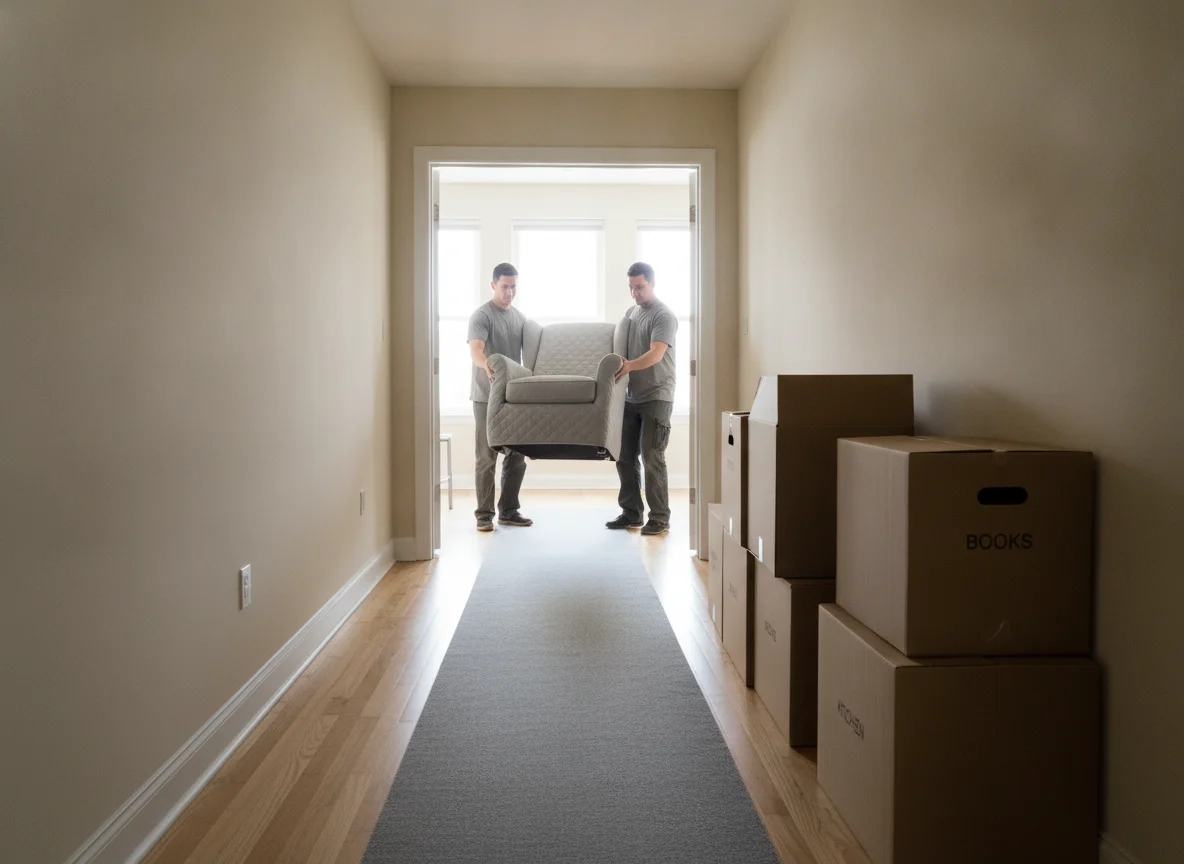
What makes an apartment move different
It isn't the amount of stuff — a one-bedroom holds a fraction of what a house move involves. It's three other things: stairs, where the truck can stand, and rules that belong to somebody other than you. Get those three sorted and an apartment move is straightforward. Ignore them and a small job turns into a long day.
Parking is usually the hardest part
Most apartments don't come with a driveway, and this is the problem people plan for last.
Ask your leasing office, before the day, where a truck is allowed to stand and for how long. Assigned spaces, visitor bays, a fire lane that legally can't be blocked, a gate code, or an access road with a turn a full-size truck can't make are all normal, and all of them are much easier to solve a week out than on the morning. If a space can be reserved or coned off, reserve it.
Where the truck ends up matters more than anything else on the day, because that walk from the door to the tailgate gets repeated on every single trip in and out of the building.
Stairs, turns, and what actually fits
The measurement that matters in an apartment isn't the room, it's the pinch point — the tightest turn between the unit and the street. Usually that's a stairwell half-landing, a corridor corner, or the front door itself.
Doors come off their hinges
When a few inches are the difference. It takes minutes and it saves both the furniture and the frame.
Sectionals and sleeper sofas
Are the classic apartment problem. A sectional separates; a sleeper doesn't, its mechanism gets strapped before it's tilted, and it's heavy in an awkward way that catches people out on a turn.
Some things were assembled inside the apartment
And genuinely cannot leave in one piece. Beds, large wardrobes, and desks are the usual suspects. Better established with a tape measure at the start than with a piece wedged in a stairwell.
Balcony routes are almost never the answer.
People ask, and occasionally it's the only way, but it needs the right conditions and the building's agreement.
Your building's rules — and your deposit
Buildings vary enormously, so ask your office rather than assume: whether moves are restricted to certain hours or days, whether they want notice, whether there's a service entrance, and — if there's an elevator — whether it can be reserved and whether the building supplies pads for it.
The part worth caring about most: damage to shared areas usually comes out of your deposit. Scuffed corridor walls, a gouged doorframe, a marked stairwell, a scratched lobby floor. Those are your money, not the building's, which is why protecting the parts of the route that aren't yours is worth as much attention as protecting your own furniture.
In practice that means runners down in shared hallways, padding on corners and doorframes, wrap on the stair rail, and pads in the elevator where the building allows them.
Roommate and partial moves
When one person moves out of a shared apartment, only some of the furniture goes — and that's the move most likely to end in an argument.
Label what's yours before the day, clearly enough that someone who has never met you can tell. Then walk the apartment with the crew and point at what's leaving before anything is lifted. Anything ambiguous gets settled between you and your roommate at that point, not by a crew making a judgment call with a sofa half off the ground.
Is a small move worth a crew?
Straight answer: sometimes it isn't. A ground-floor studio, a friend with a pickup, and one afternoon is a perfectly good plan, and nobody needs to pretend otherwise. What changes the answer:
Stairs
Especially more than one flight, and doubly so if both addresses have them.
One or two awkward pieces
A sleeper sofa, a large TV, a heavy dresser — in an otherwise small load. If it's one item and nothing else, that's a furniture move rather than an apartment move.
No access to a vehicle
Or nobody who wants to drive a rental truck.
A deadline you can't miss
Like keys due back the same day — see same-day moving if the timeline is genuinely tight.
A back you'd rather not risk.
People underestimate this one until the week after.
Already have a vehicle sorted and only want the carrying done? Book loading and unloading help instead — it's the cheaper half of the job.
Move-out day and your lease
Leave a gap between the truck pulling away and your inspection. An empty apartment shows every mark, and you want time to deal with what you find.
Anything mounted on the walls — TV brackets, floating shelves, hooks, curtain hardware — normally has to come down and the holes patched, so check what your lease actually says rather than guessing. Cleaning is easiest with the place empty and hardest with a deadline, so build it into the same day rather than the next one. If the packing is what's holding you up, packing services can take a one-bedroom off your hands quickly.
What affects the price
The floor you're on and the number of flights, how far the truck ends up from the door, how much has to be dismantled to get out, and whether both ends are apartments — two sets of stairs is a very different job from one.
Timing matters more here than in most moves. Leases overwhelmingly turn over at the end of the month, which means every apartment in town is moving in the same few days. If your dates have any flexibility at all, the middle of the month is the quieter half.
We cover {{area.full}}.
Common questions
I'm on the third floor with no elevator. Is that a problem?
No, it's ordinary — walk-ups are most of what apartment moving is. It does affect how long the job takes and what it costs, so say which floor you're on when you first get in touch rather than leaving it as a surprise for the morning.
My building only allows moves at certain times. Can you work with that?
Yes, and it's common. Find out the exact window and any notice your office needs, and tell us early — a restricted window is a scheduling detail when it's known in advance and a serious problem when it isn't.
Can you move just some of the furniture?
Yes. Partial moves out of shared apartments are routine. Label what's going, walk it with the crew first, and it stays simple.
What if I can't get into my new place the same day I have to be out?
Common with leases that don't overlap, and it's handled by storing your things in between rather than by cramming everything into a car. Raise it as soon as you suspect the dates won't line up.
Ready to book?
Tell us which floor you're on now and which floor you're going to, whether either building has an elevator, when you need it done, and roughly how much is coming. If there's a sleeper sofa, a sectional, or anything you suspect came into the apartment in pieces, say so up front.