Long Distance Movers in {{area.main}}
{{business.name}} handles long-distance moves out of {{area.alt}} — households, apartments, and small offices going to another state or across the country. Your things are inventoried, wrapped, loaded, and delivered to the new address, with the fragile and awkward items crated rather than hoped for. Send us both addresses and roughly what's coming, and we'll take it from there.
What counts as a long-distance move
A move that crosses a state line, or one long enough that loading and delivery can't happen on the same day. That makes it a different job from a local move in three ways that matter to you: it's planned around a delivery window rather than an afternoon, your shipment is measured and documented far more carefully, and the mover is operating under interstate rules that give you specific things you're entitled to ask for.
Most of this page is about using that to your advantage.
The part everyone worries about: when your things arrive
Interstate shipments are given a delivery spread — a range of dates rather than a single one. That's normal and it isn't a dodge: a truck running two thousand miles is subject to weather, mandated driver rest, and the other shipments sharing the trailer, and a mover promising an exact hour a thousand miles out is promising something they can't control.
What you should expect is a spread you're told about before you book, not after your things are on the truck. Ask what it is, ask what happens if it slips, and ask how you'll be kept informed while the shipment is moving. A shipment traveling with others on a consolidated trailer usually has a wider spread than one moving on its own, and that difference is worth understanding before you choose.
The practical consequence is the thing almost nobody plans for: you need to be able to live at the new address for the length of that spread without your furniture. More on that below.
What moves the price
Long-distance pricing is driven by different things than a local move:
How much you're taking.
The single biggest factor, which is also the one you have the most control over. Everything you don't move is weight you don't pay for.
How far it's going, and where.
Distance, but also the route — a delivery to a major corridor is a different proposition from one to a rural address hours off the interstate.
Stairs and carry distance.
At origin and destination both.
Who does the packing, and how much of it.
See packing services.
Timing.
Summer and month-end are the busiest windows in the industry, and lead times stretch accordingly.
Extras.
Crating for art, stone, and glass, storage between load and delivery, extra pickup or drop stops, and shipping a vehicle.
Access at both ends.
If a full-size trailer can't legally or physically reach the address — a narrow street, a low branch or bridge, a tight turn, a steep or unpaved driveway, a weight-restricted road — the shipment has to be transferred to a smaller truck to complete the delivery. That's called a shuttle, it's common, and it's one of the most frequent unwelcome surprises on delivery day. Ask about it while you're still getting quotes, and describe both streets honestly.
Questions worth asking any long-distance mover
This is the section that will save you the most, so ask all of these — of us and of everyone else you're considering:
Are you the carrier, or a broker?
A broker sells your job to a carrier you haven't met and haven't vetted. Both exist legitimately, but you should know which one you're talking to before you hand over a deposit.
What's your USDOT number?
Every interstate household goods mover has one, and you can look it up yourself on the FMCSA's public register to see the operating authority and complaint history attached to it.
Is the estimate binding, non-binding, or not-to-exceed?
These behave very differently when the actual shipment turns out heavier than the estimate. Get the answer in writing.
Will someone survey the home, in person or by video?
An estimate produced without anyone looking at what's being moved is a guess, and guesses get revised on loading day.
What's the delivery spread, and what happens if it's missed?
Interstate delivery is quoted as a window of days rather than a date, and that window is part of the contract. Ask how wide it is, when it starts counting, and what the mover does if it passes.
Will my shipment share a trailer with other shipments?
Most long-distance loads do, and that is ordinary rather than a warning sign. It is worth knowing, because a shared trailer is the reason delivery is a window and not a day.
Will a shuttle be needed at either end?
Ask while you are still getting quotes. If a full-size trailer cannot reach either address, the shipment has to be transferred to a smaller truck, and that is far better known in advance than discovered on delivery day.
What deposit is required?
A modest one is ordinary. A large upfront demand, or pressure to pay it before anything is in writing, is worth a second opinion.
What protection applies to my things, and what does the upgraded option cover?
The default level of liability on an interstate move is far lower than most people assume. Ask what it's calculated on before you decide whether to upgrade.
What we do so it survives the trip
A long-distance move isn't a short drive — it's days of road vibration, a trailer loaded and unloaded more than once, and other people's shipments stacked alongside yours. That changes how things are prepared:
Everything is inventoried and condition-tagged before it goes on the truck
So what left the house and what arrived can actually be compared. Check that inventory against your own eyes at delivery, before you sign anything.
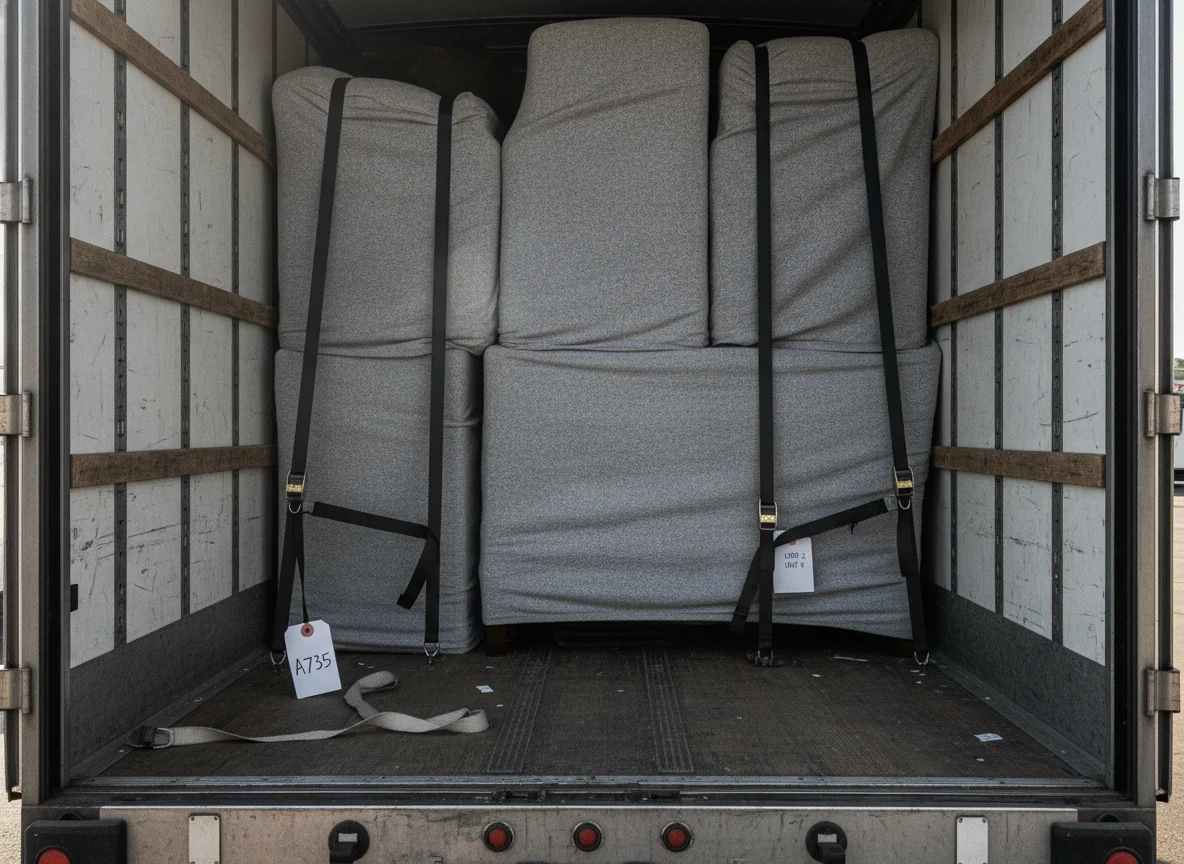
Pad-wrapped and then secured, not blanket-draped.
A blanket that slips off in the first hundred miles has protected nothing for the remaining nineteen hundred.
Stone, glass, marble, mirrors, and art get crated
Rather than wrapped. A stone top has almost no strength across its face and won't survive days of vibration lying flat.
Mattresses travel in cartons, not bags
On a long haul — a bag is fine for a trip across town and useless against a week of abrasion.
Flat-pack furniture gets an honest verdict.
Particleboard that has already been taken apart once is rarely worth what it costs in weight to send across the country, and it often doesn't arrive square. We'll say so rather than load it and let you find out at the far end.
Electronics are boxed upright
TVs in purpose-made cartons, never flat with weight on the panel.
Loads are built to stay put.
Heavy square goods low and against the walls, cartons stacked and tied off, nothing free to shift when the trailer takes a bend at speed.
What can't go on the truck
Flammables and corrosives
Gasoline, propane, paint thinner, aerosols, pool chemicals, ammunition, fireworks. Mowers and generators only with the tank drained and the plug pulled.
Perishables and open food.
A shipment in transit for a week is not a refrigerator.
Live plants.
Several states inspect or refuse plants at the line for agricultural reasons, and few plants survive a dark trailer anyway.
Pets.
Always with you, never in the load.
Anything irreplaceable.
Documents, passports, medication, jewelry, laptops, hard drives, keys, and anything sentimental travel in your own vehicle. If losing it would ruin the move, it doesn't go on the truck.
Getting ready
Purge before you pack, not after you arrive. On a long-distance move you pay to transport every box, so the cheapest carton is the one that never gets loaded. This is the one piece of preparation with a direct effect on what you spend.
Photograph anything valuable before it's wrapped, and note serial numbers on electronics. It takes an hour and it makes any later conversation about condition a short one.
Pack for the gap. Between the day the truck loads and the day it delivers, you need to live — clothes for the weather at the far end, medication, chargers, work equipment, school things, bedding, a few kitchen basics, and the paperwork for the move itself. That goes in your car or your suitcase, not on the truck. People who skip this step end up buying a second set of everything.
Label cartons with the room they're going to, and keep your own inventory list alongside the mover's.
We cover {{area.full}}.
Common questions
How far ahead should I book a long-distance move?
Earlier than a local one. Interstate jobs have to be fitted into a route rather than a day, so the further ahead you are, the more say you have over your loading date. If you're moving in summer or over a month-end, that's the busiest part of the calendar and worth planning around.
Can you move my car too?
Vehicle transport is usually arranged separately from the household shipment, on a different truck and often with a different timeline. Ask about it early rather than at the end, because it affects how you plan to get yourself to the new address.
What if my new place isn't ready when the truck is?
That's common, and it's handled by storing the shipment between load and delivery. Raise it as soon as you know there might be a gap — a planned storage arrangement is straightforward, an unplanned one on delivery day is not.
Can I pack my own boxes?
Yes, and plenty of people do to keep costs down. Be aware that liability for a carton packed by its owner is treated differently from one packed by the mover, so ask exactly how that works before deciding which cartons you'll do yourself.
Ready to get moving?
Send both addresses, your rough timeline, how many bedrooms you're moving, and anything oversized or fragile that needs planning around. That's enough to start.